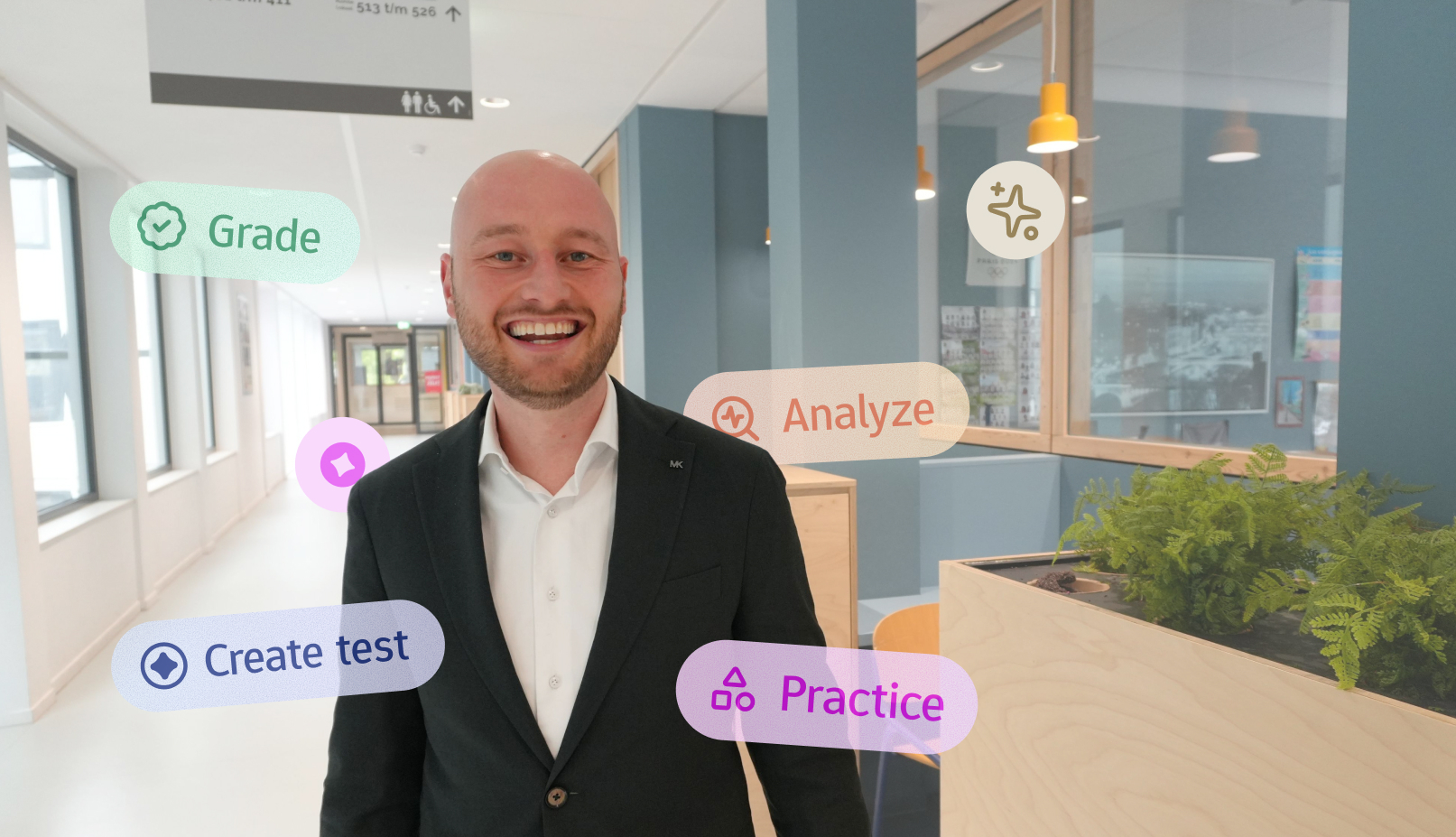
Paul van Soest is the principal of De Goudse Waarden Heemskerkstraat in Gouda, or as he calls himself: a passionate principal. He's also still in front of the class himself as a geography teacher. De Goudse Waarden is one of the first schools in the Netherlands to work with Examplary structurally: as a pilot school they helped shape the product last school year across a series of co-creation sessions. We spoke with Paul about the workload he sees as a school leader, why he deliberately brought sceptical teachers into the pilot, and what surprised him.
You were one of the first schools in the Netherlands to actively get started with AI. What drove that?
"Easing workload has been a big theme in education for years. I've always taught myself and I think it's important that teachers keep their focus on the children. But teachers lose an enormous amount of time to grading. My hope is that AI can raise the quality there: that it gets faster and more consistent, but that the teacher stays in the lead. Say a teacher saves eight hours a week. Then you spend four hours on analysis: what is this assessment telling us, what does that mean for my lessons? And four hours on other things: go exercise, go for a walk, do something fun. To take the edge off those peaks."
As a school leader, what do you actually notice of that workload?
"The conversations in the staff room around an exam week: how many colleagues are busy coordinating tests, creating tests, grading. And the peaks in work that generates. You have colleagues who shut themselves away at school until half past five. Others disappear to the library or go and work at home. It's an intense period for everyone."
How did you handle it yourself as a geography teacher?
"Around the exam weeks and finals it was mostly evening work: switch your brain off and plough through. Because putting it off didn't feel right towards the students, they're waiting for their results too. And you start to dread the pile, so you'd rather get the pain over with. Sometimes you also shoot yourself in the foot with a grading scheme that's too complex, or you have to revise a few questions with the department afterwards. That simply takes time, because you want to do those students justice. And that principle counts for more than keeping track of hours."
"Around the exam weeks and finals it was mostly evening work: switch your brain off and plough through"
As a pilot partner you took part in five co-creation sessions. What do you make of the quality of the tests teachers create with Examplary?
"At the start of the pilot it was at a decent level, especially for the junior years. But at some point you could load in the exam syllabus, select a domain, attach source materials, and then some really good questions came out. You still have to edit and adjust, but in the creation process that saves a lot of time. Not every teacher is a good test writer. Some are very good at it and enjoy it. Others reach for textbook tests. This gives you more options to work with as a teacher."
What's the advantage of making your own test with AI compared to a textbook test?
"You can tune the test more closely to where you are with the student. In geography you can use local contexts, for example. They already know the contexts from the book, so you take something else to see whether they can apply it in an unfamiliar context too. You can even put students' names in it, simply because it's fun. 'Tobias and Paul went into town and came across this, what would it be?' That connects much better to the world they live in."
"Not every teacher is a good test writer"
You deliberately chose sceptical teachers for the pilot. Why?
"We looked for teachers with a critical attitude towards AI who set a high bar for their assessment. That's been good for the process too. After the first session there were eight or nine pages of improvements. But that's exactly what you want if you want to get it working in practice. I've seen the evolution in that, from a nice idea to a product that fits practice better and better. And we're now at the point where we want to test it more broadly for certain subjects and year groups."
What surprised you most during the pilot?
"The development speed of the product. In the beginning I thought, from my background as a geography teacher: nice, a little map quiz, taking some monotonous work off my hands. But I notice that Examplary is getting stronger with longer texts, source-based questions and practice spaces as well. Where I first thought it was something you'd use now and then, like Kahoot, a fun little tool on the side, I now see that it can become a permanent fixture in how we teach."
"Where I first thought: a fun little tool on the side. I now see it can become a permanent fixture in education"
What does it take to adopt AI tooling more broadly within a school?
"As a board you need a vision on AI in the first place. A code of conduct, the boundaries you act within. A training plan belongs with that: what do you offer colleagues, but also, what do you offer students? Within our foundation I wrote that code of conduct and set up the training programme for the different locations. Other school leaders are glad I'm taking the lead on it. They recognise it as a development they want to do something with, but as a way of strengthening the teaching team. Not so the AI takes the work over."
You keep emphasising that the teacher has to stay in the lead. Why does that matter so much?
"It can't be that a student scores badly and a teacher thinks: I have no idea why, because the AI did the grading. The teacher has to move forward with that student in their learning. They have the overview and they know, didactically and pedagogically, what that student needs to make progress. That's the professional, and they come first."
How do you think students and parents view AI-supported grading?
"Communication is central to that. If it's clear that the grading scheme comes from the teachers or the department, and that the teacher still checks the complex cases themselves, then it doesn't have to be a problem. The time you save you can put into improving your lessons. And in the end every parent wants the same thing the teachers want: the best possible education for that group of students. You have a shared interest. That this can help serve that interest, getting that message across clearly is important."
Last question: where are we in a year's time?
"Let me start with my doom scenario: we have very well-trained teachers in the field of AI, they look at it hypercritically and say 'nice process, but this isn't it'. But I think we're working towards my positive scenario, in which our colleagues save significant time and can strengthen their teaching with it. Not only individually, but at department level too. Teachers often do have the skills for that kind of analysis, but not the time. If you give that time back, it can deliver an enormous amount."
"Teachers often do have the skills for that kind of analysis, but not the time"