

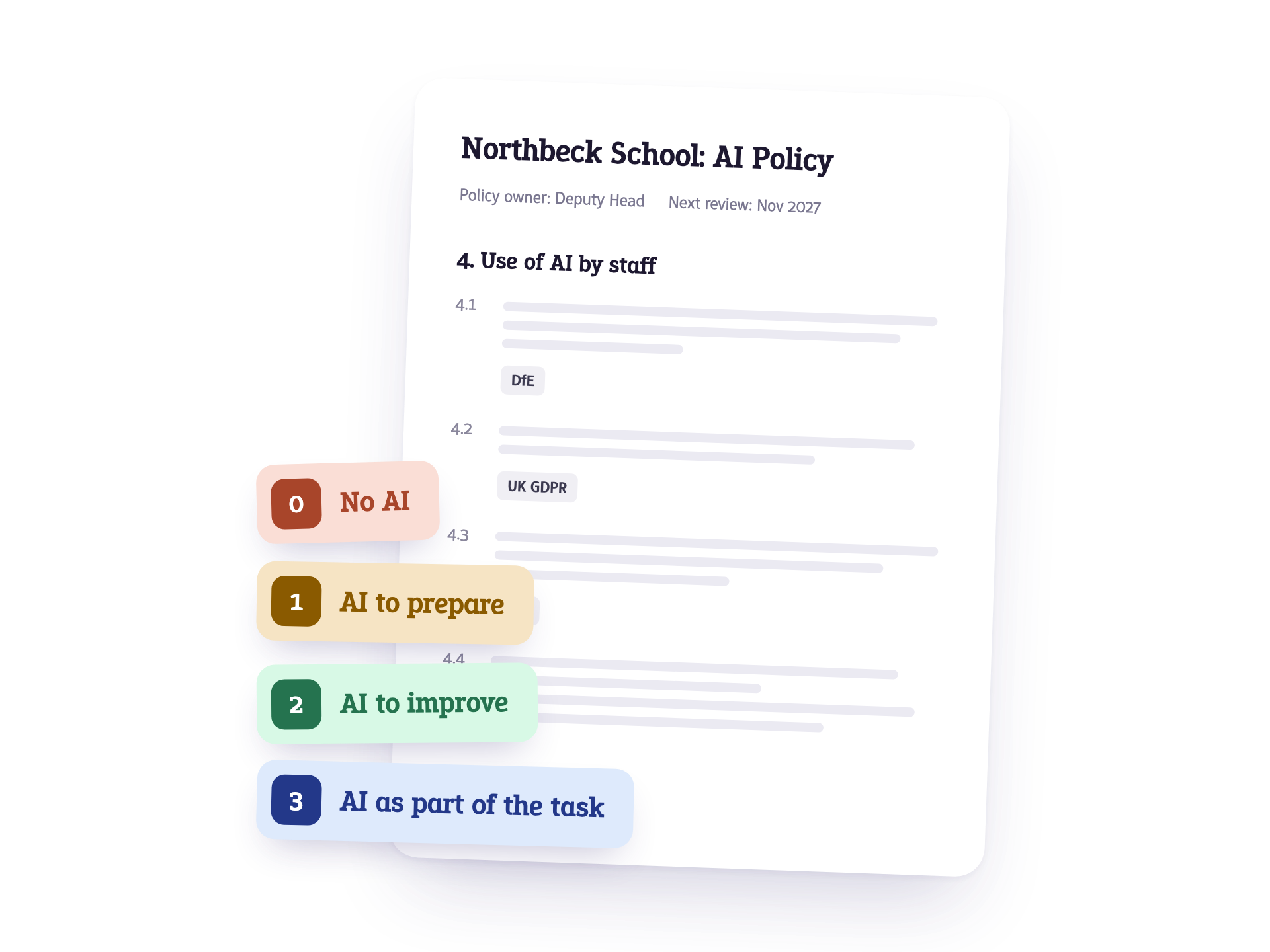
Pupils use AI whether or not the handbook mentions it. A good policy tells them and their teachers what each task allows and who to ask.
We read what the DfE, KCSIE and JCQ ask of schools, along with dozens of existing school AI policies. We've put together eight tips and a model policy builder, which gives you a starting point in 2 minutes, customised for your school.
Why now
Three in four teachers in England now use AI for work, up from about half a year earlier. Two in three say their school has no rules for how pupils use it. In the same survey, 66% of secondary teachers said pupils' critical thinking had declined because of AI, according to the NEU's State of Education survey.
No law requires a document called "AI policy". However, KCSIE, JCQ and data protection law do expect you to have decided how your school uses AI, and a policy is where you write those decisions down.
What the rules say
- DfE policy paper. You choose where to use AI. Safety comes first, and the department sees "more immediate benefits and fewer risks from teacher-facing use".
- Product safety standards. Thirteen things an AI tool should do, such as filter harmful content and give hints before answers. Nobody audits them, so ask each supplier for a written response.
- KCSIE 2026. AI-made abuse images and deepfakes are safeguarding matters. Review your filtering and monitoring at least once a year.
- JCQ. Pupils can't use AI in exams. In coursework they name the tool and date and keep their prompts. Your malpractice policy must cover AI.
- Data protection. Ask your DPO before personal data goes into an AI tool, and use approved tools only. Pupils' work is not training data.
- Ofsted. Inspectors look at your decisions about AI and their effect on pupils. Expect to be asked which risks you weighed before bringing a tool in.
In Wales, Scotland or Northern Ireland? The principles are the same, but each nation publishes its own guidance: Hwb's guidance, Scotland's guidelines and guardrails (your local authority writes the policy) and DE Circular 2026/02.
Eight tips before you start writing
1. Start with what you believe about learning
Tools change from term to term, while your view of what pupils should be able to do unaided stays put. Write that view down in two sentences before you list any tools. The DfE's leadership toolkit asks for the same thing: an AI vision for the school.
2. Say yes to teachers first
The DfE sees the clearest benefits in teacher-facing use, such as planning lessons and adapting a resource for one pupil. A first pass at marking fits too, as long as the teacher checks it. Teachers who use AI well can then show pupils how.
3. Don't ban what you can't see
In a 2026 US survey, 59% of teens whose school blocked an AI tool switched to their own device. A ban moves the use to bedrooms and phones, where you can't guide it. Keeping pupil-facing AI out of lessons for now is a fair choice. If you make it, tell pupils why and teach them how the tools work anyway.
4. Label every task
Only one of the school policies we read gave teachers a shared way to tell pupils what a task allows. Without one, pupils guess and each teacher sets different rules. Showing one of four levels at the top of every worksheet fixes most of that.
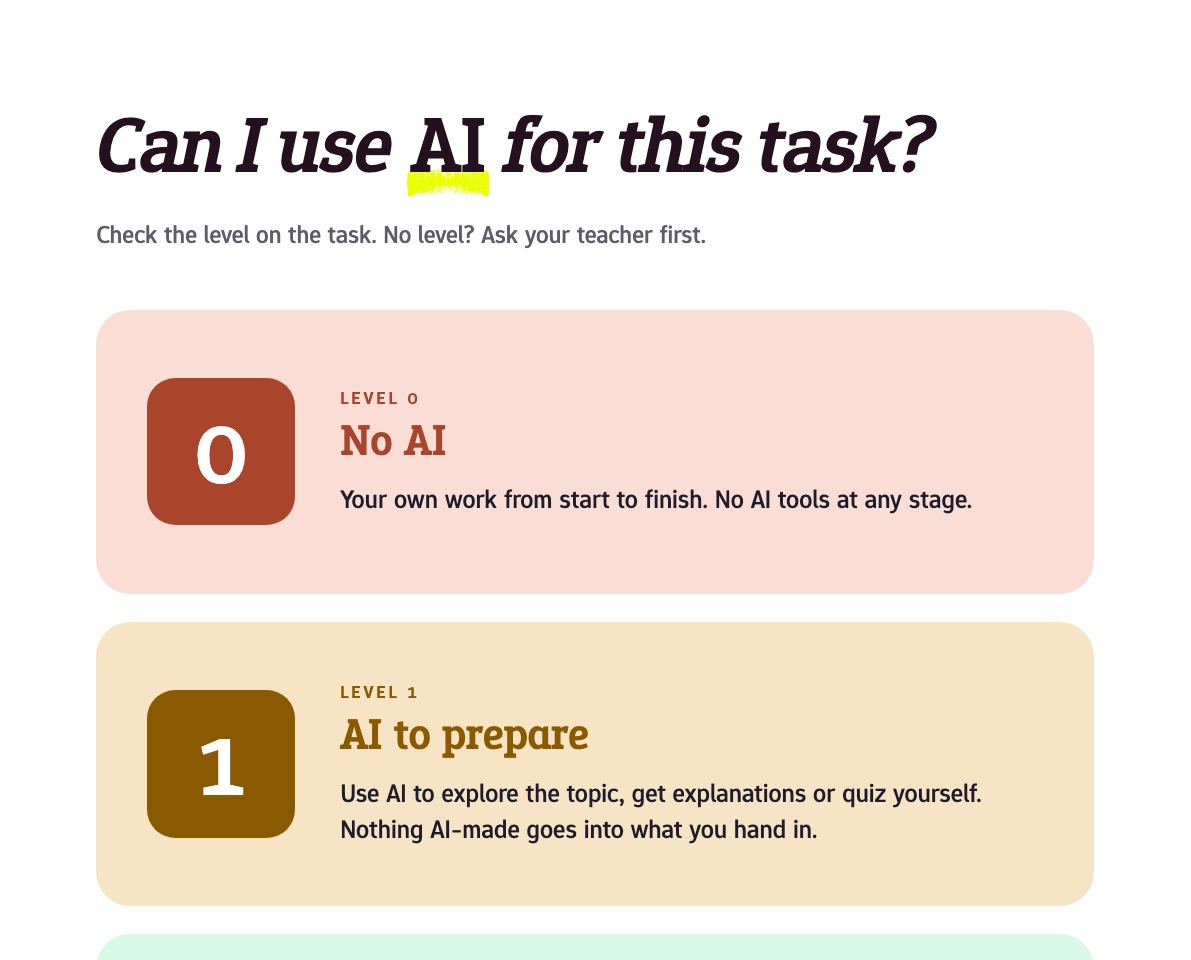
- Level 0: No AI
Your own work from start to finish. No AI tools at any stage.
- Level 1: AI to prepare
Use AI to explore the topic, get explanations or quiz yourself. Nothing AI-made goes into what you hand in.
- Level 2: AI to improve
Make your own version first. Then AI may give feedback or help with wording. Say what you used and how.
- Level 3: AI as part of the task
The task asks you to use AI. Show your prompts and judge what it gave you.
5. Make pupils think first
In a 2025 study by Bastani and colleagues, about 1,000 Turkish secondary pupils practised maths with a chatbot. They did 48% better in practice and 17% worse on the exam. A version that gave hints instead of answers did no harm. Ask pupils to draft first and use AI second, and choose pupil tools that hint before they answer, as the DfE's standards expect.
6. Don't rely on a detector
JCQ says a detection tool can't be your only evidence, and warns that these tools produce false alarms as well as misses. Teachers have better checks already: ask for drafts and have the pupil talk you through the work. Setting part of the writing in class helps too.
7. Keep names out and a tool list in
The rule for staff fits on a sticky note: no pupil names or personal details in a tool that isn't on the approved list. Put that list in an appendix so you can update it without rewriting the policy, and name the person to ask.
8. Name an owner and a review date
JCQ wants a senior leader to review the AI part of your malpractice policy each year, so put the whole policy in the calendar next to your safeguarding review. Name an AI lead, and make AI a standing item in department planning. If all questions still go to that one person a year from now, the rest of the school hasn't learned much.
Build your first draft
Answer a few questions and get a model policy for a school in England, written in policy language. Each rule carries a tag that shows where it comes from. Treat it as a first draft for staff to discuss. It isn't legal advice.
[School name]: Artificial Intelligence (AI) Policy
Policy owner: Deputy HeadteacherApproved by: the governing bodyApproved: November 2026Next review: November 2027
1. Purpose and scope
This policy sets out how [School name] uses artificial intelligence (AI), in particular generative AI. It applies to all staff, governors, trustees, volunteers and pupils, on school and personal devices, wherever AI is used for school work or school business.
AI includes features built into other software, such as writing assistants, search summaries and office tools.JCQ
The school supports staff in using AI to reduce workload and improve teaching, and teaches pupils to use AI well within clear limits set for each task.DfE
This policy should be read with the Child Protection and Safeguarding, Online Safety, Data Protection, Behaviour, Acceptable Use, Assessment, Homework, Non-examination Assessment, Malpractice and Complaints policies and the Staff Code of Conduct.
2. Principles
People stay responsible. AI may assist, but a named person remains accountable for every decision and every piece of work.DfE
Safety comes first. No use of AI may compromise the safety or wellbeing of pupils.DfE
Learning comes first. AI should support, and never replace, pupils' own thinking, effort, creativity and judgement.
We are honest about AI. Staff and pupils acknowledge when and how they have used it.DfE
We protect privacy. Personal data is kept out of AI tools unless the school has approved that use.UK GDPR
We check for error and bias. AI output can be inaccurate, biased or out of date and is always checked before it is relied on.DfE
3. Roles and responsibilities
The governing body approves this policy and receives a report on its operation at least once a year.
The headteacher has overall responsibility for the safe and effective use of AI in the school.
The Deputy Headteacher is the school's AI lead: they maintain the approved tools register, coordinate training, lead the annual review and support departments in making their own decisions about AI.
The data protection officer (DPO) advises on data protection and is consulted before any AI tool is used with personal data.DfE
The designated safeguarding lead (DSL) leads on online safety, including risks from AI, and on filtering and monitoring.KCSIE
The exams officer and heads of department ensure that JCQ and awarding body rules on AI are followed.JCQ
All staff and pupils follow this policy and report concerns.
4. Approved tools
Only AI tools on the approved tools register (Appendix A) may be used with school accounts, with school data or with pupils.
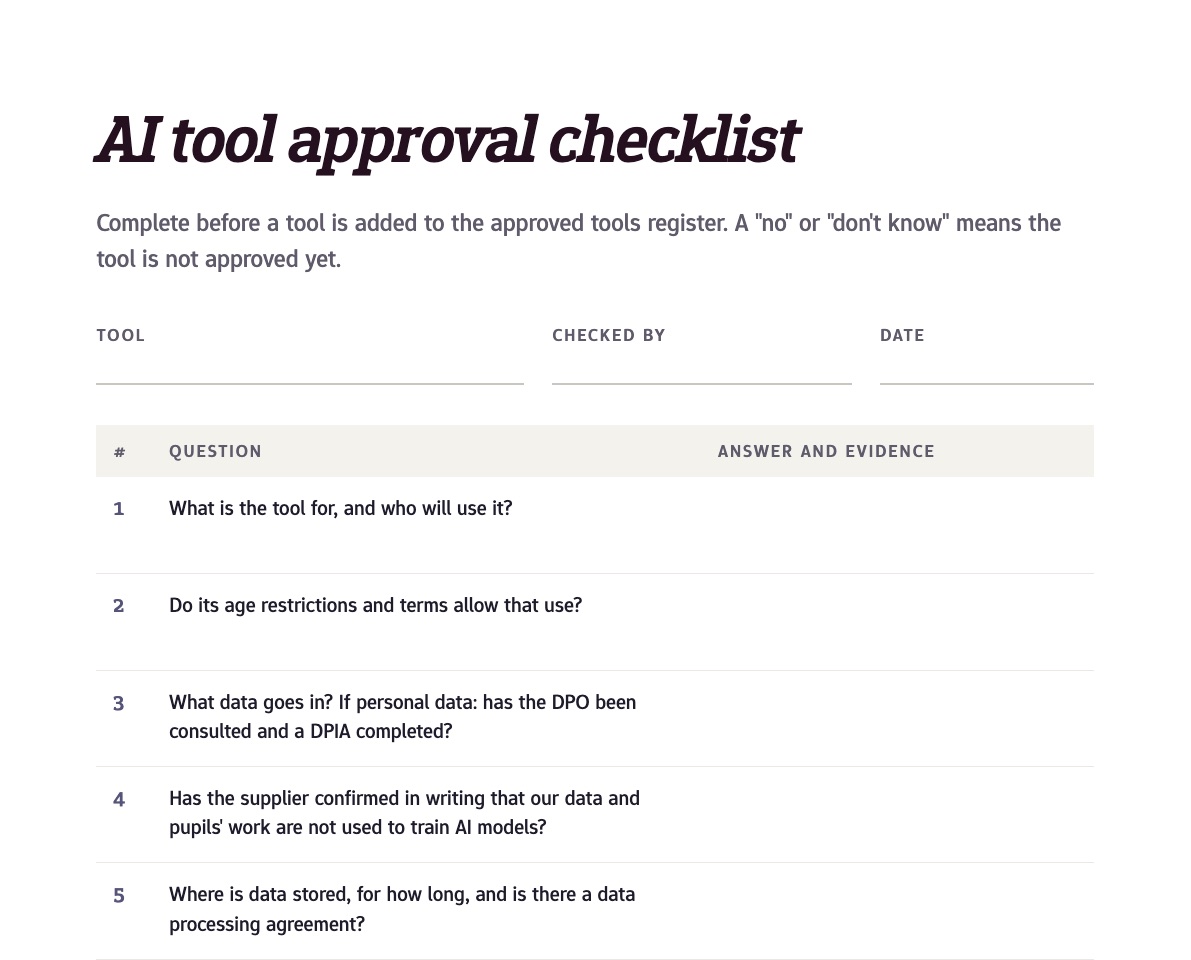
Before a tool is added, the AI lead confirms: its educational or operational purpose; that the DPO has been consulted and a data protection impact assessment completed where personal data is processed; that the supplier has responded to the DfE generative AI product safety standards; that its age restrictions and terms permit the intended use; that school data and pupils' work are not used to train AI models; and, for pupil-facing tools, that filtering and monitoring cover it.DfE standards
Staff may propose a tool to the AI lead. The register is reviewed at least annually.
5. Use of AI by staff
Staff are encouraged to use approved tools to reduce workload and improve teaching, for example in planning, creating and adapting resources, designing assessments and drafting administrative documents.DfE
Staff check AI output for accuracy, bias and suitability before using it. The member of staff remains responsible for the quality and content of the final work.DfE
Staff do not enter personal data about pupils, parents or colleagues into an AI tool unless Appendix A states that the tool is approved for that purpose.UK GDPR
Staff do not enter pupils' original work into a tool that could use it to train AI models, unless the pupil and, for pupils under 18, a parent or carer has given permission.DfE
AI is never the sole basis for a decision with a significant effect on a pupil or member of staff, including grades, sanctions, admissions, special educational needs, safeguarding and employment decisions.UK GDPR
Staff may use approved tools to suggest marks and feedback. The teacher reviews every suggestion before it reaches the pupil and remains responsible for the mark and the feedback.JCQ
Staff tell pupils when AI has helped to produce marks or feedback on their work.
6. Use of AI by pupils
Pupils in Year 9 and above may use approved AI tools as set out in this section. Younger pupils use AI only in lessons, under the direct supervision of a teacher.DfE
The school complies with the age restrictions set by each tool. Where a tool requires parental consent, that consent is obtained first.DfE
Pupils may use AI to support their learning within the limits set for each task.
In school, pupils use only approved tools, on school accounts and under supervision, with filtering and monitoring in place.KCSIE
Teachers state the AI level for each homework task and assessment (Appendix B). Where no level is given, Level 1 applies.
When pupils use AI in work they hand in, they state the name of the tool, the date and what they used it for, and keep their prompts and the AI output so that they can show them if asked.JCQ
Pupils must be able to explain any work they submit.
Pupils must not: present AI-generated work as their own; enter personal information about themselves or others into an AI tool; create or share content that is harmful, sexual, bullying or deceptive, including fake images, audio or video of pupils or staff; or use AI to get around the school's filtering.KCSIE
7. Homework and internal assessment
Teachers design tasks with AI in mind. Important assessments include work completed under supervision, and evidence of process such as plans, drafts and discussion may be required.JCQ
Where a teacher suspects that AI has been misused, they first talk to the pupil and compare the work with the pupil's earlier work. The pupil has the chance to explain.
The school does not use AI detection software, because its results are unreliable and can lead to false accusations.JCQ
Responses are proportionate and aim to put the learning right first. Repeated or serious misuse is dealt with under the Behaviour policy.
8. Qualifications: coursework, non-examination assessment and exams
The school follows the current JCQ guidance "AI Use in Assessments" and the rules of each awarding body. The AI sections of the Malpractice policy and the Non-examination Assessment policy are reviewed each year by a senior leader.JCQ
AI tools are not permitted in examinations or in any assessment taken under exam conditions. Wearable technology that can give access to AI is prohibited in the exam room.JCQ
Before starting any non-examination assessment, each candidate receives the JCQ "Information for candidates" document on AI, and the school explains the rules to candidates and their parents or carers.JCQ
Where an awarding body allows AI in coursework, candidates must acknowledge every use: the name of the tool, the date, a non-editable copy of the prompts and output, a short explanation of how it was used and, where AI changed their text, the original version. This includes help with planning, structure, spelling, punctuation and grammar.JCQ
Candidates receive no credit for content produced by AI. Teachers accept work for assessment only when they are confident that it is the candidate's own.JCQ
Concerns raised before a candidate signs the declaration of authentication are dealt with by the school. Concerns after signing are reported to the awarding body in line with JCQ procedures.JCQ
AI is never the sole marker of work that counts towards a qualification. A teacher reviews the whole piece of work and is responsible for the mark.JCQ
9. Data protection and intellectual property
Personal data is processed in line with UK GDPR, the Data Protection Act 2018 and the school's Data Protection policy. The privacy notice explains which AI tools process personal data and why.DfE
Entering personal data into a tool that is not approved for that purpose is reported to the DPO without delay and handled as a potential data breach.UK GDPR
Pupils own the copyright in their original work. The school does not allow that work to be used to train AI models without permission.DfE
Staff check that AI-generated material does not infringe the rights of others before it is published or shared outside the school.DfE
10. Safeguarding and wellbeing
Risks from AI form part of online safety: inaccurate or harmful content, bullying and impersonation, scams, and AI-generated sexual images, including deepfakes. They are covered in staff safeguarding training and in teaching pupils to stay safe online.KCSIE
Any sexual image of a child, including one generated or altered by AI, is treated as a child protection matter. Staff report it to the DSL immediately and do not view, copy or forward it.KCSIE
The school's filtering and monitoring cover AI tools and are reviewed at least once every academic year.KCSIE
Pupils are taught that an AI chatbot is not a substitute for a trusted adult. The school does not use tools that present themselves as a friend or companion, and expects pupil-facing tools to direct a pupil in distress to human help.DfE standards
11. AI literacy and training
All staff receive training on this policy at induction and at least annually, drawing on the DfE's "Using AI in education settings" materials.DfE
Further training is matched to staff roles and experience. Departments discuss the use of AI as part of curriculum and assessment planning.
Pupils are taught, in Computing, PSHE and across subjects, how generative AI works, where it goes wrong, how to use it to learn more and not less, and how to acknowledge it.
12. Equal access
No task requires a paid AI tool or access to AI at home. Where a task involves AI, the school provides access or an alternative.
When choosing tools, the school considers pupils with special educational needs and disabilities, and the Public Sector Equality Duty.DfE standards
13. Working with parents and carers
This policy is published on the school website. Parents and carers are told each year which AI tools pupils use and how they can support good habits at home.DfE
14. Breaches, concerns and complaints
Breaches by pupils are dealt with under the Behaviour policy and, for qualifications, the Malpractice policy. Breaches by staff are dealt with under the Staff Code of Conduct and disciplinary procedures.
Anyone who believes that the use of AI has led to an error or unfair treatment may raise it with the AI lead or through the Complaints policy.
15. Monitoring and review
The AI lead reports to the governing body each year on the tools in use, training and incidents. This policy is reviewed at least annually, and sooner if DfE, KCSIE or JCQ guidance changes. Next review: November 2027.JCQ
The review draws on the views of staff, pupils and parents. It considers whether the use of AI has improved learning and reduced workload, and identifies tools or tasks that should stop.
Appendix A: Approved tools register
| Tool | Who may use it | Approved uses | Personal data |
|---|---|---|---|
| School-licensed AI assistant (example) | Staff | Planning, resources, admin drafts | Only as set out in the DPIA |
| Oak National Academy Aila (example) | Staff | Lesson planning | No |
| Examplary (example) | Staff and pupils | Tests, practice, marking suggestions checked by the teacher | Only as set out in the DPIA |
Appendix B: AI levels for tasks
| Level | Name | What it means |
|---|---|---|
| 0 | No AI | Your own work from start to finish. No AI tools at any stage. |
| 1 | AI to prepare | Use AI to explore the topic, get explanations or quiz yourself. Nothing AI-made goes into what you hand in. |
| 2 | AI to improve | Make your own version first. Then AI may give feedback or help with wording. Say what you used and how. |
| 3 | AI as part of the task | The task asks you to use AI. Show your prompts and judge what it gave you. |
Everything stays in your browser: nothing you type here is sent to us.
Take it to the staff room
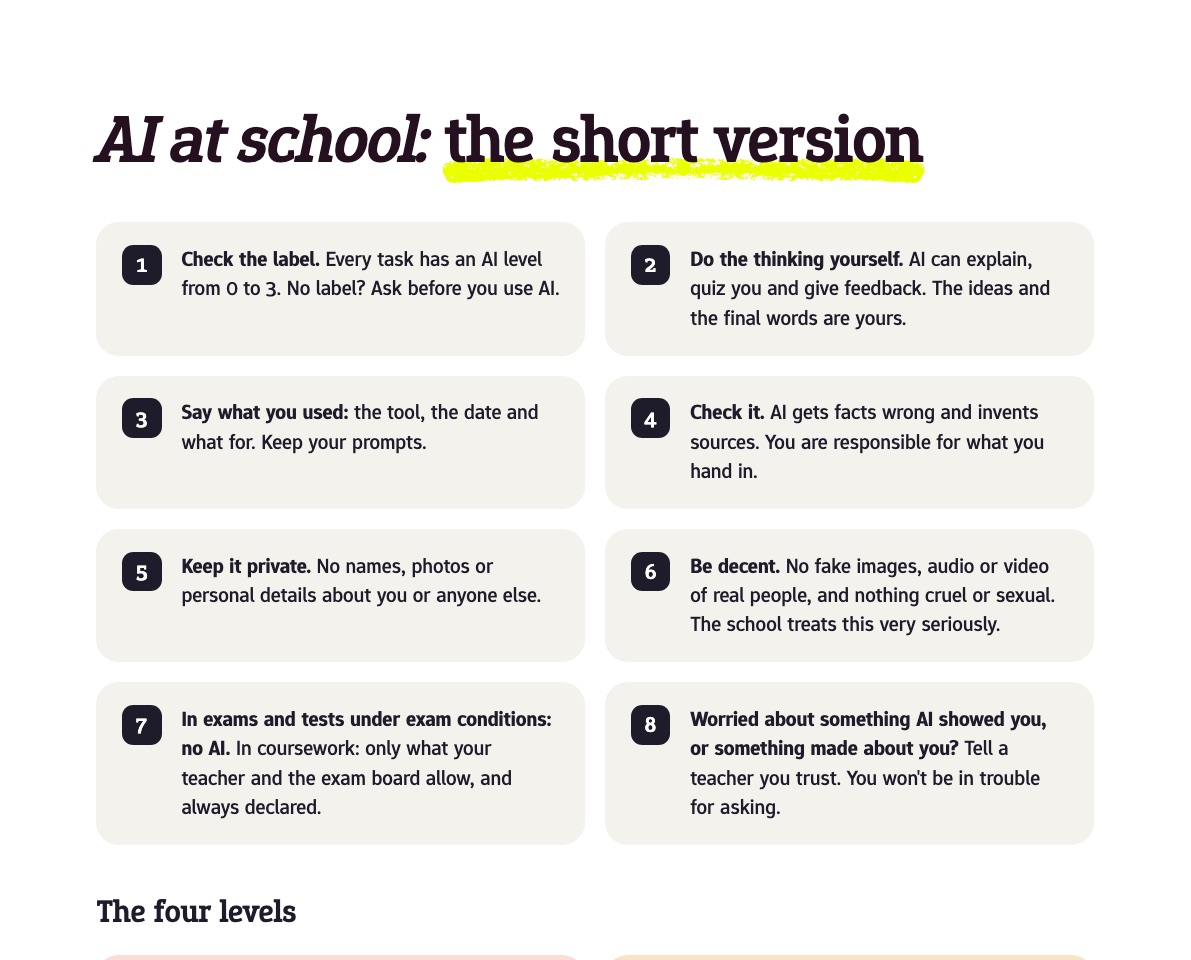
Four more files to share with staff, pupils and parents. Print them as they are, or open the Word versions and add your school's name.
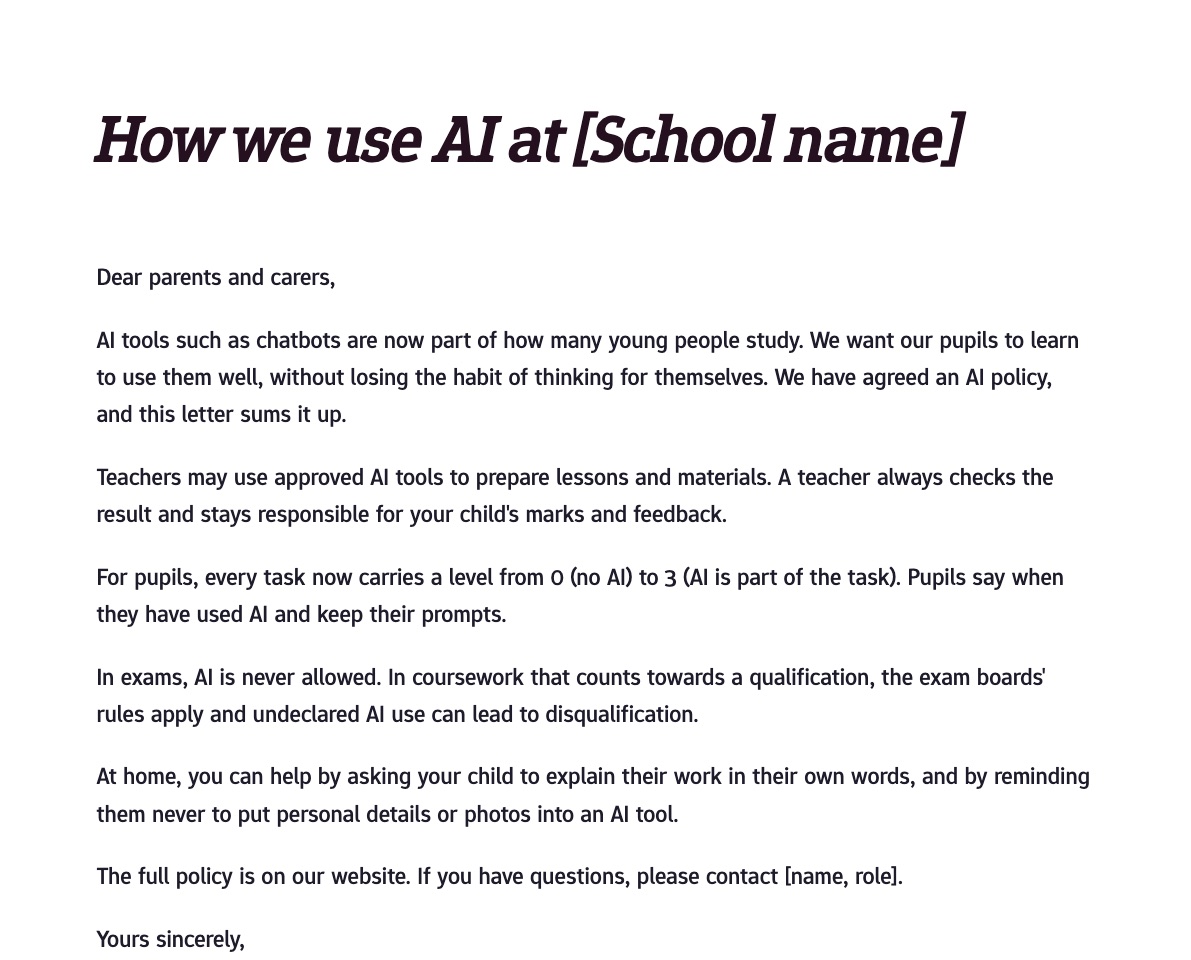
Letter to parents
A short letter that explains the agreements and how to help at home. Add your school's name and go.
After the policy
A school can have a policy and a well-attended training day and still work the way it did before. Education leader Stephanie Holt argues that a policy is worth most when it records decisions the school understands and can act on.
Take the draft above to a staff meeting and invite the sceptics. A doubtful colleague may have spotted the weak process that an enthusiast missed. Training needs the same care: a teacher new to AI needs one approved tool and one use worth their time, while an experienced colleague is ready to rethink an assessment.
At the review, Holt suggests asking these questions instead of counting licences:
- Do teachers choose with confidence when AI helps learning, and when to leave it out?
- Can pupils explain the thinking behind work they made with AI?
- Has workload gone down, or do we produce more of the same?
- What have we stopped doing?
Where Examplary fits
Examplary follows the same idea as this guide. It drafts tests and practice from your own materials and suggests marks and feedback, and you check them before a pupil sees anything. Pupils get practice that asks them to think first.
This guide is not legal advice. Ask your data protection officer and exams officer to read your final version. The model policy is written for England, so schools elsewhere in the UK should swap in their own national guidance.
Sources for this article
- DfE: Generative AI in education and the product safety standards
- Keeping children safe in education 2026
- JCQ: AI use in assessments
- DfE: Generative AI and data protection in schools
- Ofsted: How Ofsted looks at AI during inspection
- DfE: Using AI in education settings, support materials
- NEU: State of Education 2026, AI
- Common Sense and NORC survey of US teens, 2026
- Bastani et al.: Generative AI without guardrails can harm learning, PNAS, 2025
- Stephanie Holt: The AI Policy Will Not Change Your School